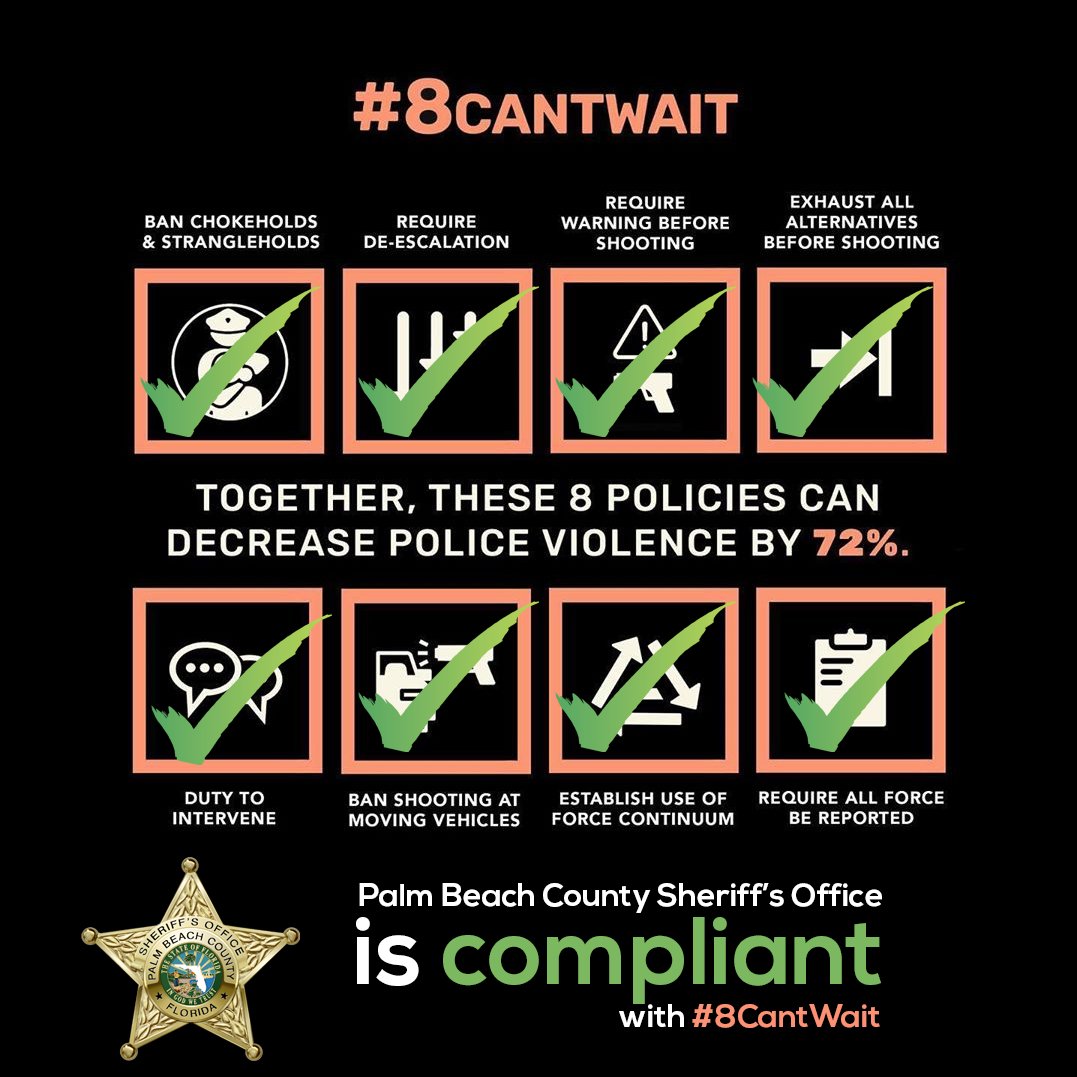


On June 16th 2020, the President of The United States signed an Executive Order on police reform amid a broad national debate sparked by the police killing of George Floyd in Minneapolis, which has itself led to heightened calls to address racial justice issues in the United States. The Palm Beach County Sheriff’s Office is in accordance with said order and has been compliant with these recommendations.
The Executive Order reads as follows:
Sec. 2. Certification and Credentialing. (a) State and local law enforcement agencies must constantly assess and improve their practices and policies to ensure transparent, safe, and accountable delivery of law enforcement services to their communities. Independent credentialing bodies can accelerate these assessments, enhance citizen confidence in law enforcement practices, and allow for the identification and correction of internal deficiencies before those deficiencies result in injury to the public or to law enforcement officers.
(b) The Attorney General shall, as appropriate and consistent with applicable law, allocate Department of Justice discretionary grant funding only to those State and local law enforcement agencies that have sought or are in the process of seeking appropriate credentials from a reputable independent credentialing body certified by the Attorney General.
(c) The Attorney General shall certify independent credentialing bodies that meet standards to be set by the Attorney General. Reputable, independent credentialing bodies, eligible for certification by the Attorney General, should address certain topics in their reviews, such as policies and training regarding use–of-force and de-escalation techniques; performance management tools, such as early warning systems that help to identify officers who may require intervention; and best practices regarding community engagement. The Attorney General’s standards for certification shall require independent credentialing bodies to, at a minimum, confirm that:
(i) the State or local law enforcement agency’s use-of-force policies adhere to all applicable Federal, State, and local laws; and
The Palm Beach County Sheriff’s Office use-of-force policies do not only adhere to the Federal, State and local laws, but they have also been reviewed and evaluated by third party agencies like the Police Executive Research Forum (PERF) and accredited by the Commission for Florida Law Enforcement Accreditation
since June 2000.
(ii) the State or local law enforcement agency’s use-of-force policies prohibit the use of chokeholds — a physical maneuver that restricts an individual’s ability to breathe for the purposes of incapacitation — except in those situations where the use of deadly force is allowed by law.
The Palm Beach County Sheriff’s Office has a no-chokeholds policy except in those situations where the use of deadly force is allowed by law. – (Please review our General Order on Use of Force Revised 6/3/20)
(d) The Attorney General shall engage with existing and prospective independent credentialing bodies to encourage them to offer a cost-effective, targeted credentialing process regarding appropriate use-of-force policies that law enforcement agencies of all sizes in urban and rural jurisdictions may access.
On March 2, 2018, the Palm Beach County Sheriff Ric Bradshaw, invited the Police Executive Research Forum (PERF) to examine PBSO policies and procedures, including the Use-of-Force policy. Here is the report to that analysis.
The Palm Beach County Sheriff’s Office has also received the highest accreditation in Law Enforcement for the sixth time by the Commission for Florida Law Enforcement.
Sec. 3. Information Sharing. (a) The Attorney General shall create a database to coordinate the sharing of information between and among Federal, State, local, tribal, and territorial law enforcement agencies concerning instances of excessive use of force related to law enforcement matters, accounting for applicable privacy and due process rights.
(b) The database described in subsection (a) of this section shall include a mechanism to track, as permissible, terminations or de-certifications of law enforcement officers, criminal convictions of law enforcement officers for on-duty conduct, and civil judgments against law enforcement officers for improper use of force. The database described in subsection (a) of this section shall account for instances where a law enforcement officer resigns or retires while under active investigation related to the use of force. The Attorney General shall take appropriate steps to ensure that the information in the database consists only of instances in which law enforcement officers were afforded fair process.
(c) The Attorney General shall regularly and periodically make available to the public aggregated and anonymized data from the database described in subsection (a) of this section, as consistent with applicable law.
(d) The Attorney General shall, as appropriate and consistent with applicable law, allocate Department of Justice discretionary grant funding only to those law enforcement agencies that submit the information described in subsection (b) of this section.
Sec. 4. Mental Health, Homelessness, and Addiction. (a) Since the mid-twentieth century, America has witnessed a reduction in targeted mental health treatment. Ineffective policies have left more individuals with mental health needs on our Nation’s streets, which has expanded the responsibilities of law enforcement officers. As a society, we must take steps to safely and humanely care for those who suffer from mental illness and substance abuse in a manner that addresses such individuals’ needs and the needs of their communities. It is the policy of the United States to promote the use of appropriate social services as the primary response to individuals who suffer from impaired mental health, homelessness, and addiction, recognizing that, because law enforcement officers often encounter such individuals suffering from these conditions in the course of their duties, all officers should be properly trained for such encounters.
Since 2014, Sheriff Ric Bradshaw instituted the Behavioral Services Unit. Currently, there are 29 people who serve under this unit and they are comprised of law enforcement, licensed therapists, case managers, and support staff.
The Behavioral Services Unit is an interdisciplinary unit of law enforcement investigators, case managers, and mental health professionals whose mission is to identify potential violent threats to the community by reactive and proactive investigations. The goal is not only to identify and prevent violent incidents to our community but ensure those who need services receive proper case management to prevent any future incidents. The Behavioral Services Unit works with local, state, and federal law enforcement officials as well as mental health professionals in an attempt to ensure a comprehensive approach to preventing community violence.
(b) The Attorney General shall, in consultation with the Secretary of Health and Human Services as appropriate, identify and develop opportunities to train law enforcement officers with respect to encounters with individuals suffering from impaired mental health, homelessness, and addiction; to increase the capacity of social workers working directly with law enforcement agencies; and to provide guidance regarding the development and implementation of co-responder programs, which involve social workers or other mental health professionals working alongside law enforcement officers so that they arrive and address situations together. The Attorney General and the Secretary of Health and Human Services shall prioritize resources, as appropriate and consistent with applicable law, to support such opportunities.
Every year, PBSO Deputies and those in our Behavior Services unit go through continuous education. Most of our staff that interacts with mental health issues in the public are licensed mental health professionals and must complete mandatory requirements for continuing education.
(c) The Secretary of Health and Human Services shall survey community-support models addressing mental health, homelessness, and addiction. Within 90 days of the date of this order, the Secretary of Health and Human Services shall summarize the results of this survey in a report to the President, through the Assistant to the President for Domestic Policy and the Director of the Office of Management and Budget, which shall include specific recommendations regarding how appropriated funds can be reallocated to support widespread adoption of successful models and recommendations for additional funding, if needed.
(d) The Secretary of Health and Human Services shall, in coordination with the Attorney General and the Director of the Office of Management and Budget, prioritize resources, as appropriate and consistent with applicable law, to implement community-support models as recommended in the report described in subsection (c) of this section.
Sec. 5. Legislation and Grant Programs. (a) The Attorney General, in consultation with the Assistant to the President for Domestic Policy and the Director of the Office of Management and Budget, shall develop and propose new legislation to the Congress that could be enacted to enhance the tools and resources available to improve law enforcement practices and build community engagement.
(b) The legislation described in subsection (a) of this section shall include recommendations to enhance current grant programs to improve law enforcement practices and build community engagement, including through:
(i) assisting State and local law enforcement agencies with implementing the credentialing process described in section 2 of this order, the reporting described in section 3 of this order, and the co responder and community-support models described in section 4 of this order;
(ii) training and technical assistance required to
adopt and implement improved use–of-force policies and procedures, including scenario-driven de-escalation techniques;
(iii) retention of high-performing law enforcement officers and recruitment of law enforcement officers who are likely to be high-performing;
(iv) confidential access to mental health services for law enforcement officers; and
(v) programs aimed at developing or improving relationships between law enforcement and the communities they serve, including through community outreach and listening sessions, and supporting non profit organizations that focus on improving stressed relationships between law enforcement officers and the communities they serve.
Palm Beach County Sheriff’s Office has a robust Community Outreach unit comprised of deputies and civilians all across Palm Beach County. These Community Outreach officers help the communities they serve by creating outreach programs like the Police Athletic League, PBSO Mentoring Youth Programs, sporting events, and much more. These individuals serve communities from impoverished areas in our western communities to our Hispanic and indigenous communities in the east. For more information, please visit: /pbso-community-outreach-in-our-tri-cities/
Sec. 6. General Provisions. (a) Nothing in this order shall be construed to impair or otherwise affect:
(i) the authority granted by law to an executive department or agency, or the head thereof; or
(ii) the functions of the Director of the Office of Management and Budget relating to budgetary, administrative, or legislative proposals.
(b) This order shall be implemented consistent with applicable law and subject to the availability of appropriations.
(c) This order is not intended to, and does not, create any right or benefit, substantive or procedural, enforceable at law or in equity by any party against the United States, its departments, agencies, or entities, its officers, employees, or agents, or any other person.
We Comply with #8CantWait